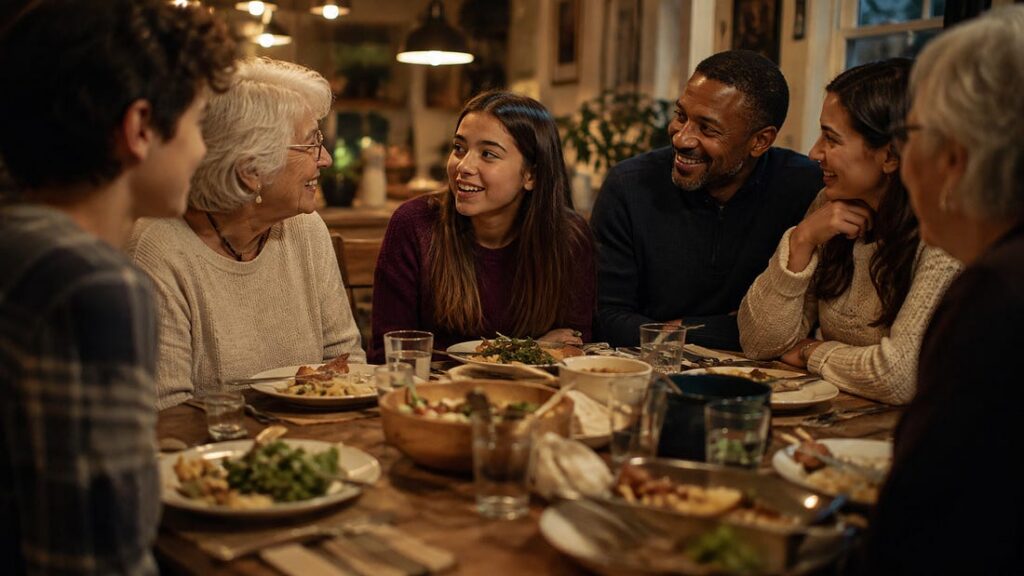
Do you remember what it was like to have the family sit together at the dinner table and engage in interesting conversation?
No cell phones, no arguments, no politics, no interruptions? Not just on Thanksgiving, but every night?
That’s a ritual many of us have lost . . . or maybe never had.
We’re reviving that ritual in San Antonio, Texas, with an event called Generations Over Dinner, an initiative from SALSA (Successfully Aging and Living in San Antonio), a program of the San Antonio Area Foundation. The idea grew out of a collaboration between Michael Hebb, author of Death Over Dinner, and Chip Conley, founder of the Modern Elder Academy.
By the end of the year, we will have exposed over 1,500 people in San Antonio to this important ritual of connection.
How Does it Work?
We bring together six to eight people, spanning at least three generations, ages twelve to ninety-plus, to sit down together around a table for a guided conversation over a family-style meal. Our dinners range from as few as four tables to 25. It sounds almost too simple to matter, but people come away transformed, because they’ve experienced something that’s unique for many of them.
They feel seen, heard, and appreciated.
Building Bridges
A thirteen-year-old girl showed up for a dinner one night, dropped off by her mom. I had the feeling she was there under duress. She was shy in that teenage way where every question feels like a spotlight. Getting more than a nod out of her took some doing. I figured she’d spend the night staring at her plate, waiting for it to be over.
She ended up seated next to a 91-year-old woman.
Picture that pairing for a second. Eighty years of life sitting between them like a canyon. Put extreme shyness and reluctance to talk into that picture. What do you even say across a gap that wide?
Turns out, more than you’d think.
That’s the magic of this whole format. It doesn’t ask you to bridge the canyon with small talk. It asks you to build a bridge with genuine interest, respect, curiosity, deep listening, and appreciation.
At the end of the night, she said something that still makes me stand in awe of this powerful idea:
“I never thought I had anything to say. But tonight I realized I have a voice.”
I think about how that moment will ripple through that young girl’s life, and through the lives of others she’ll encounter along the way.
Why This Works
We tend to treat age gaps like walls, something you either avoid or awkwardly climb over at holidays. But a wall assumes there’s nothing on the other side worth reaching. What that 91-year-old woman gave a thirteen-year-old girl, without probably even trying that hard, was proof there’s plenty on the other side.
And what that girl gave back, her fresh eyes, her nervous honesty, her willingness to try, was something the older generation at that table doesn’t get handed every day either.
That’s really the quiet magic of this whole thing. Nobody is cast as the wise elder dispensing lessons, and nobody is cast as the kid who just needs to listen. Everybody at the table is both a student and a teacher. The format just gives you cover to admit it.
We talk a lot these days about the loneliness epidemic, and the numbers back it up. Intergenerational contact has dropped something like 40% over the past two decades. A huge share of older adults report chronic loneliness.
None of that is abstract once you’ve watched a shy kid find her voice at a table with a woman six decades her senior. Loneliness isn’t just an absence of people around you.
It’s an absence of people who see you.
That’s what this dinner fixed, at least for one night, for one girl.
 Consider Pulling Up a Chair
If you’ve read this far, I’m guessing something in this story tugged at you. Maybe it’s a grandkid you wish you talked to more. Maybe it’s a curiosity about what the older folks in your life actually think about, beyond the small talk you default to. Maybe you’re just tired of scrolling past connection instead of having it.
Maybe you’re tired of hearing opinions without curiosity or questions.
You don’t need a special occasion. You don’t need a big budget. You need a table, some food, a handful of people spanning a few generations, and a willingness to ask each other real questions.
I went to one dinner and watched a thirteen-year-old discover she had something to say.
I have no idea what would happen at yours. But maybe it’s worth finding out.