Coming to the Aid of a Neighbor in Crisis
Laura Giacomoni smiled at the sight of her two sons and their two cousins splashing in the waist-deep water of a creek down a small hill from where she stood.
It was early in the evening of July 3, 2025. Giacomoni, Executive Director of Development and Donor Services at the San Antonio Area Foundation (SAAFdn), tried not to think about the busy work week waiting on Monday. Instead, she was thankful for the Area Foundation’s first-ever weeklong summer hiatus and the vacation cabin her family rented near Kerrville, Texas.
A holiday weekend awaited. As Giacomoni basked in the balmy evening sunshine and the kids squirted bugs with water pistols, only a tiny concern crossed her mind.
“I hope I packed enough sunscreen,” she remembered thinking.
Like virtually everyone else in the Texas Hill Country, she never saw the deluge coming.
By the time she awoke to pre-dawn darkness on July 4, Giacomoni and her family were at ground zero of one of the deadliest flash floods in Texas history.
And in the hours and days to come, she and her Area Foundation colleagues stepped forward to help lead a philanthropic response that also proved to be historic. The Kerrville-based Community Foundation of the Texas Hill Country (CFTHC) and its newly mobilized Kerr County Relief Fund came to epitomize the way community foundations can lead during a moment of extraordinary need. And the Area Foundation became a model of collaborative support by surging expert staff, leadership and resources to help a peer successfully manage a crisis.
The resulting collaboration allowed the Relief Fund to raise more than $110 million (and counting) for urgent and long-term disaster recovery in the Hill Country community that the neighboring foundations both serve.
“The Area Foundation was our closest neighbor and our huge ally,” CFTHC CEO Austin Dickson reflected. “We were in a moment, and they stepped up. That was a true gift.”
Within a week of the disaster, CFTHC announced its first $5 million in aid to support local first responders and nonprofits providing food, housing aid and other crisis care. Over the next few months, CFTHC committed some $60 million more to help families and businesses rebuild, repair and cope and fund the revitalization of the region’s civic and cultural fabric.
“The Community Foundation of the Texas Hill Country had four employees” when the flood hit, Area Foundation CEO Nadege Souvenir said. “They were scaled to meet the day-to-day needs of supporting their community – but they weren’t scaled for anything like a massive natural disaster. We are their neighbor, and we had the organizational infrastructure to handle the scale and scope of change that happened overnight.”
That’s why there was no choice for the Area Foundation but to mobilize – immediately.
“We were in a unique position to be able to help a smaller community foundation at the center of a crisis,” Souvenir said. “People care. They want to help. They want to know who they can give to and feel secure knowing their help will flow to where it is needed. It’s philanthropy’s job to crowd out confusion and fear. So, it was critical for the local community foundation to succeed in that moment.
“They were at risk of being just overwhelmed. We could not let them fail.”
A Wall of Water, a Wave of Charity
Around 1:40 a.m. on Friday, July 4, two massive weather systems collided over the Hill Country. As Kerr County residents slept, clouds unleashed biblical torrents of rain. The typically lazy Guadalupe River became a roiling tsunami, rising 30 feet in just three hours.
Yet the severity of flash flooding along the river had not yet come into focus as dawn broke. In Kerrville, Dickson awoke to a mass of texts describing flooded roads, sodden homes and uncertainty. He was still in his pajamas, surrounded by holiday-weekend house guests, when he established the Kerr County Relief Fund at 9:47 a.m.
“When we opened the fund, I had no idea of the destruction,” he recalled. “I just knew there would be some damage, and people would want an outlet to help.”
But the news darkened quickly. Later that morning, Souvenir called from San Antonio, an hour’s drive south of Dickson’s Kerrville office, to offer a helping hand. The two community foundations’ service areas overlap (Bandera and Kendall counties), and they share common donors and grantees. They has also worked together before, most notably in the philanthropic response to the deadly mass shooting at Robb Elementary School in nearby Uvalde.
Souvenir volunteered to spread the word about the relief fund to other Texas community foundations and to regional and national funders in her network. She connected Dickson with Giacomoni, who had volunteered to stay in Kerrville to help. And Souvenir invited Dickson to come to her San Antonio office to develop a plan.
A Tide of Pain – and Compassion
With every passing hour, authorities pieced together an ever-bleaker picture of the scale of the catastrophe. By late Friday, it became clear that more than 100 people were dead or missing, including dozens of children from upstream summer camps. At least 2,000 homes, businesses and other structures were damaged or destroyed.
At early news briefings, Kerr County officials publicized Dickson’s fund and CFTHC’s website and phone number. His foundation’s limited staff and crew of volunteers were quickly inundated. By Saturday, its web hosting service warned that the website was nearing collapse and switched CFTHC to a separate server. Its staff and volunteers couldn’t keep up with donor calls, taking down phone numbers and promising to call back. Dickson faced dozens of interview requests from media outlets around the world.
A Neighbor’s Helping Hands
Dickson was exhausted when the Area Foundation welcomed him to its office just days after the flood. He and his team had been working 20-hour days. Online donations were coming in at a rate of two every second.
He had a massive portfolio of corporate and foundation donors who had inquired and were awaiting callbacks. U.S. Mail trucks pulled up several times a day to unload sacks of mailed donations and well wishes. His phone rang nonstop with calls and texts from flood victims and first responders.
And five people he knew personally had perished in the flood.
“We need help,” Dickson told Souvenir and her senior leaders. “We can’t do this alone.”
Dickson broke down in tears, vulnerable and humbled at having to ask. Souvenir told him to just pause and breathe. Then she gave him a hug.
“I could literally feel him decompress,” she said.
Together, they drew up a plan for the Area Foundation to lend CFTHC up to 10 staff members – including several senior leaders – to support the smaller foundation during the unprecedented surge in demand for the Hill Country community foundation’s expertise and leadership. Souvenir agreed to lend these staff members pro bono, to help with gift processing, finance, operations, governance, grants management, human resources and more.
Lisa Brunsvold, SAAFdn’s Chief Development Officer, recalled that when high-profile institutional philanthropists learned that the Area Foundation was augmenting CFTHC’s capacity to administer and dispense the surge of charitable gifts, “you could almost hear the pressure valve release.”
The collaboration from a peer made the moment more manageable and helped get resources into victims’ hands almost instantly, Dickson said.
“She [Souvenir] said, ‘I stand ready to support you,’ he said. “And within one week of the flood, we had a press conference where we announced $5 million in grants and that $30 million had already been raised. Our message was, ‘We are in control and help is on the way.’ Nadege came up and stood with me then. And she gave me some guidance, and coaching and honestly just moral support.”
The Area Foundation also extended other assistance, including:
- Relief-fund publicity: SAAFdn worked with Santikos Entertainment to feature a CFTHC-produced disaster relief video in Santikos theaters through the end of August, raising awareness and encouraging donations.
- IT help: SAAFdn worked with Santikos tech staffers to set up new computers, printers and scanners CFTHC bought to manage the donation surge.
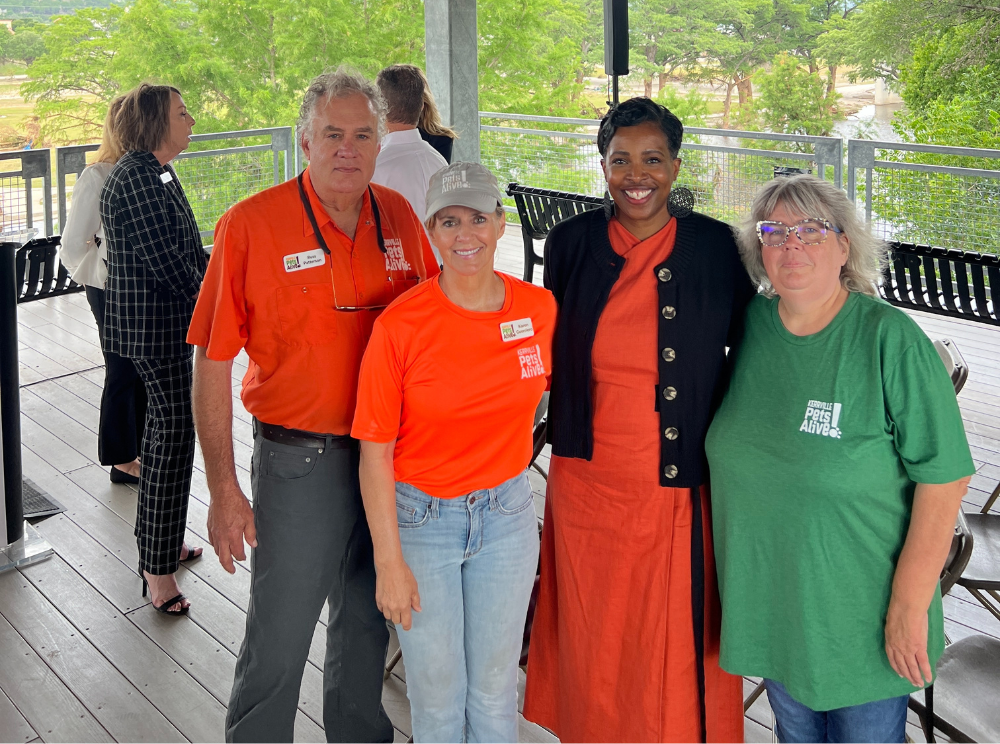
- Funding support: SAAFdn pledged $50,000 to the relief fund as well as directly investing into helping rebuild the community: $50,000 grants each to Kerrville Pets Alive, LiftFund and the Kerrville Daily Times, as well as $20,000 to Texas Public Radio.
Along with the loaned senior leaders, other SAAFdn staffers also found ways to offer a helping hand.
“Across the Area Foundation, people were volunteering to do things that were not part of their job description,” Souvenir said. “Everyone who could help wanted to help.”
Teamwork on a Heavy Lift
Giacomoni parked herself at a desk at CFTHC’s Kerrville office and took charge of one of the most promising but daunting challenges: navigating the bureaucratic maze of corporate philanthropy.
She handled the portfolio of institutional donor prospects awaiting callbacks. Giacomoni spent weeks calling them back, one by one. Each company and foundation had its own requirements. She gave flood updates, handled legal paperwork, answered questions about grantees and consulted with lawyers.
“She did that over and over again – 15 million dollars’ worth of times,” Dickson said in amazement. “She was physically here, leading by example – on the phone, taking Zoom meetings and stewarding these donors on our behalf.”
Gradually, the backlog shrunk. The donation total rose. Other loaned SAAFdn staff simultaneously stabilized operations, grants processing, finance, and hiring, ensuring the fund could move at both speed and scale. And Dickson found crucial breathing room.
“We do not have a development officer here. No one on staff does fundraising – that’s my job. But there are not enough hours in a day, not enough phone lines and only one of me,” he said.
SAAFdn Chief Operating Officer, Arenda Burns, took on another challenge: CFTHC needed to hire a senior program officer for long-term response work. Burns collaborated with Dickson and his staff on a job description. Then Burns and her team advertised the position, screened applicants, interviewed candidates and referred finalists to Dickson.
Sharlene Casaclang, SAAFdn’s Treasury Manager, commuted north to work alongside CFTHC Business Manager Amy Rector, documenting gifts, preparing receipts and leading volunteer data processors.
As each loaned staff member took on tasks to help the neighboring community foundation, their San Antonio colleagues stepped up to take work off the volunteers’ desks, whether for the Area Foundation or for the flood relief effort.
“Anybody who raised their hand and said they are happy to help with work got overwhelmed with work, and then their work poured on to others,” Dickson said.
By the time the personnel aid agreement ended in August, and all 10 loaned staff returned to full-time SAAFdn work, Burns said, virtually every San Antonio staff member had contributed to the flood-relief effort, directly or indirectly. The value of the donated time surpassed $80,000, but the impact proved to be priceless.
Impact and Gratitude
As autumn arrived, the situation had settled considerably. The Kerr County Relief Fund had already helped more than 700 families and 200 businesses and funded two dozen case workers from other nonprofits who were dedicated exclusively to tending to victims’ needs. Grants are funding repairs and rebuilding of homes, schools, parks, a senior center, Kerrville’s arts center and more. Roughly $40 million remains under stewardship to address long-term resilience, unforeseen needs and underlying vulnerabilities.
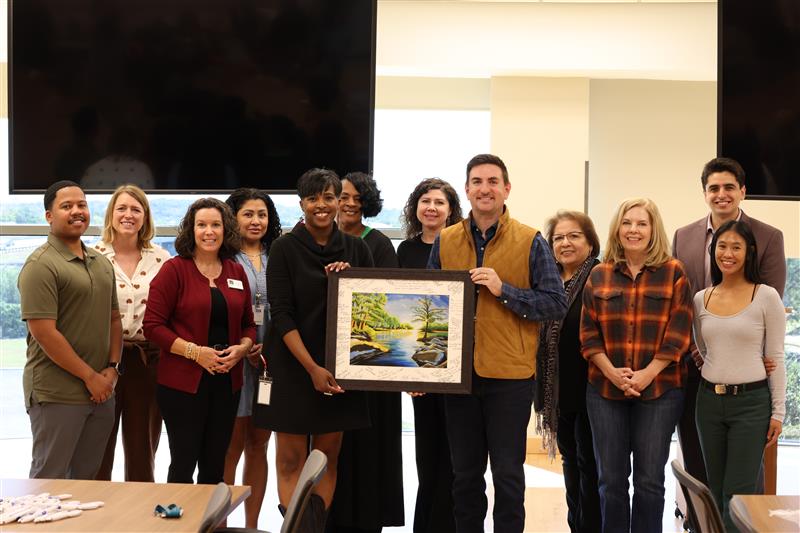
In late October, Dickson drove down to the Area Foundation office bearing thank-you gifts and bought lunch for the staff. He handed out gift baskets and hosted a lighthearted awards ceremony to honor his helpers.
The staff laughed as he handed out recognition trophies, such as “The Midnight Log-In Award” to three loaned finance staffers whose time-stamped donation-log entries during the peak surge showed them working as late as 2 a.m., and “The Matrix Award” to Philanthropic Advisor Carlo Tolentino for “getting lost in the matrix” while untangling countless technical issues with major donations.
Then Dickson gave what he called “a seven-minute TED talk,” methodically detailing the impact of the two foundations’ collaboration and how it helped an entire city and thousands of struggling neighbors recover.
“That turned out to be really meaningful,” he recalled later. “Employees I’d never met came up to me and said, ‘Thanks for sharing all of that. I had no idea.’”
From the Heart of San Antonio
Ultimately, Souvenir noted, that gift came from all of San Antonio. A community foundation represents and expresses the goodwill of its community, and of the philanthropists whose dollars and trust make the work of the Area Foundation possible every day, in perpetuity. And the trust, governance, and partnership model that guides the Area Foundation’s daily work made this unprecedented response possible.
“Our community has enabled, empowered and entrusted us to take care of this place we love,” Souvenir said. “We just showed what a community foundation can really do – in an innovative, creative, real and impactful way. “And seeing how our team rose to the moment and gave life to the community’s trust – that has been one of the proudest moments of my career.”
###
Sidebar:
Community Foundations Grow into New Roles
Community foundations began more than a century ago as a form of collaborative, perpetual public trust. Through them, philanthropists large and small pool their money into investment funds that generate earnings, which in turn fund grants to nonprofits, scholarships and other civic-minded endeavors.
That funding role remains crucial. But over the years, community foundations have evolved into high-profile forces for local civic progress, convenors of public policy conversations and advocates for the broader nonprofit sector.
Recently, community foundations have emerged in yet another leadership role: Serving as the primary fundraisers and recovery coordinators in the aftermath of natural disasters. From Hurricane Harvey to wildfires in Hawaii and California to 2024’s flash floods in the Appalachian region, local community foundations have raised hundreds of millions of dollars and distributed it to agencies to fund immediate and longer-term recovery.
It’s another evolution of community foundations’ characteristic servant leadership, according to San Antonio Area Foundation CEO Nadege Souvenir.
“I can’t think of any organization that’s better suited to do that than a community foundation,” she affirmed. “Community foundations are local. They understand local needs. They have vetted the local nonprofit agencies that can help and know where the gaps are. They are outstanding at collaborating and team building. They hold the trust of donors and the community. And they have the processes and governance in place to ensure that trust is well placed.”